Clodagh Molloy
Artist-Maker, Curator and Participatory Practitioner

The Fragile Body:
The Language of Healing
Donner wie Blitz, Munich
March–April 2026
Coinciding with Munich Jewellery Week / Schmuck 2026
The Fragile Body: The Language of Healing is a group exhibition that brings together 46 international artists and makers working across contemporary jewellery, sculpture, body adornment, and photography. Presented at Donner wie Blitz during Munich Jewellery Week 2026, the exhibition explores the relationship between art and health, and the body as a site of vulnerability, resilience, memory, and care.
Through intimate material practices and embodied narratives, the exhibition considers creative making as an act of healing, reflection, and endurance. Jewellery is approached not only as adornment, but as a language. One that communicates tenderness, protection, emotional labour, and lived experience. The works engage themes of fragility and strength, repair and transformation, revealing how materials can hold traces of touch, time, and human connection.
Rather than presenting a singular narrative of healing, The Fragile Body offers multiple perspectives on how bodies navigate pain, resilience, identity, and care. The exhibition creates space for both personal and collective stories, inviting audiences to reflect on the physical, emotional, and social dimensions of the body.
Displayed in the gallery windows of Donner wie Blitz, the exhibition extends beyond the interior space to engage the public street. A publication accompanies the project, documenting the works and further exploring the exhibition’s themes.
Opening Gathering:
Thursday 5th March 2026, 14:30–16:00
Venue:
Donner wie Blitz
Donnersbergerstraße 20A, Munich
Curator:
Clodagh Molloy
Selected Artists:
Aino-Astrid Gaedtke, Anne Blok, Ayla Tur, Barbara Schwager, Bernie Leahy, Cindy Zhaohan Li, Clodagh Molloy, Da Ye Kim, Dimitra Papamerkouri, Elena Eftodi, Esteban Erosky, Eva Lynch, Grit-Ute Zille, Helena Renner, Henrike Altes, HIlde Dramstad, Himani Aggarwal, Janne Peltokangas, Jeanne-Sophie Aas, Julia Boix-Vives, Karin van Paassen, Lauren Kalman, Lena Grewenig, Lorenz Mager, Lucia Whelan, Maria Benedita, Minjeong Kim, Natasha Heaslip, Niamh Wright, Olga van Doorn, Pamela Fernanda Suárez Iturrieta, Rachael Colley, Roberta Modulo, Rosa Nogués Freixas, Sarah Vassø, Sayaka Ito, Sophia Zobel, Sophie Lowe, Stephie Morawetz, Teresa Faris, Teresa Milheiro, Ute van der Plaats, Virág Luca Boncz, Yingying Qiu, Yuqi Fan, Ziqi Yuan.


Aino-Astrid Gaedtke
@ainoastridgaedtke
Northern traditions and lived experience inform Aino-Astrid Gaedtke’s vibrant works, where strong colour, simple form, and historical techniques meet contemporary craft.
In "Apron to a Little Girl", the apron becomes more than protection. It is a symbolic shield for the body and a site of healing. Drawing from personal trauma and the language of art therapy, Gaedtke builds a visual vocabulary where colour, symbol, and wordplay carry emotional weight: orange for courage, green for hope, red for pain; mermaids as protectors, blossoms and seeds as renewal.
A subtle yet powerful shift transforms Wut (anger) into Mut (courage), suggesting how care, creativity, and time can reframe vulnerability into strength.

Anne Blok
@anneblokart
Through jewellery, Anne Blok’s Life Wrapped Up reflects on the fragile bodies of those she loves most, transforming lived experience into objects of care, resilience, and hope.
Blok’s work is rooted in the reality of family life shaped by a rare congenital disease. One that cannot yet be cured. While vulnerability is ever-present, it is met by forces far stronger: love, care, patience, humour, and hope. Making art becomes both a refuge and a way of holding what cannot be repaired, offering comfort in the face of uncertainty.
Graduating as a jewellery designer last summer marked an important milestone, affirming jewellery as a language through which these experiences can be expressed and shared.
Material choices are central to the work’s meaning. Delicate tulle embodies the fragility of life. Soft, protective, and easily torn, while brass elements speak of perseverance, courage, and enduring love. Together, they form quiet, intimate gestures that wrap, shield, and honour vulnerable bodies.

Ayla Tur
@aylatur_jewellery
Ayla Tur’s practice explores the intimate dialogue between body, material, and memory, moving fluidly between sculptural objects, wearable forms, and performative gestures. Working with experimental and natural materials, her pieces become quiet records of touch, care, and attention. Each mark shaped slowly by hand.
This body of work emerges from a deeply personal place: the absence of her father and the protective bonds of family. Fragility and resilience are held in tension through materials such as eggshell, charcoal, human hair, clay, and thread. Eggshell appears as a delicate yet sheltering dome, symbolising maternal protection, while charcoal, dense and transformative, marks loss, memory, and endurance.
Tur’s works function as talismans and vessels, carrying traces of lineage, ritual, and embodied emotion. Through weaving, layering, and sculpting, grief is translated into material form, creating spaces for reflection, healing, and quiet reconciliation. These pieces invite viewers to pause at fragile thresholds, between presence and absence, vulnerability and strength. To sense the invisible threads that connect body, mind, and spirit.
Part of The Fragile Body: The Language of Healing.

Barbara Schwager
@schwagerbarbara
Barbara Schwager’s practice bridges design, medicine, and contemporary jewellery, shaped by a childhood immersed in Bauhaus architecture and the illustrated worlds of Tomi Ungerer. Originally trained as an orthodontist, Schwager spent over 25 years working intimately with the mouth and face, creating what she describes as “jewellery for the body,” shaping smiles through precision, care, and restraint.
Seeking a broader, more open language of adornment, she turned to jewellery design five years ago. Freed from the necessity of standardised outcomes, her work explores material, form, and surprise, embracing the expressive and communicative potential of jewellery. For Schwager, adornment becomes a way of interacting with the world, sparking conversation, curiosity, and moments of connection.
Her work for The Fragile Body: The Language of Healing reflects on intimacy, care, and unseen communication. In A Call Through the Umbilical Cord, she explores the quiet, internal dialogue between parent and unborn child. Responding to the idea that sound can travel through the body, Schwager placed a music box on her belly and listened inward, creating a gentle, private exchange. The piece speaks to love, vulnerability, and the invisible bonds that form before words exist.

Bernie Leahy
@BernieLeahyArt
Bernie Leahy’s practice explores the body as a site of vulnerability, protection, and quiet resilience. Working with material contrasts and sensory cues, her work reflects on how power and powerlessness coexist within the human body. How nurture, growth, and care can themselves become forms of strength.
Her series SYMBIOTICS draws from the Greek syn (together) and biotics (living), reflecting on states of interdependence. The works consider moments of protection and growth alongside fragility and loss of control, revealing the body as both shelter and uncertainty.
Within the work BREATHE, the viewer is invited into an intimate act of discovery. Hidden drawings are revealed only through close investigation, while the faint scent of vintage compacts lingers activating memory and sensation beyond the visual. Colour, texture, and surface carry layered narratives that shift gently as the piece is handled and observed.
Leahy’s materials reference the human body both symbolically and personally, evoking sensations of touch: cold and hard meeting soft and delicate. These contrasts awaken memory through the senses, allowing the work to unfold slowly.
Together, these pieces narrate stories of a quiet continuum, where intimacy, fragility, and connection persist through subtle acts of attention.

Cindy Zhaohan Li
@cindy_zhaohanli_artworks
Cindy Zhaohan Li is a London-based multidisciplinary designer–maker working across jewellery, body artefacts, and sensory design. Her practice explores touch as a fragile language, asking how material interaction can rebuild intimacy and awareness between body and self.
Drawn to natural materials and their quiet, trustworthy qualities, Li creates objects that speak through the skin. The body becomes both site and participant, invited to feel before the eyes judge. At the heart of her work is the belief that touch is not only personal, but collective: a language capable of restoring presence in a world increasingly detached from the body.
For The Fragile Body: The Language of Healing, Li presents UN-BRUSH, a series of wearable body brushes that blur the boundary between jewellery and sensory tools. Rooted in childhood memories of her mother’s touch. The gentle strokes of a comb through hair, the comforting yet tingling rub on bare skin. The work reflects on touch as a form of care and early communication.
Each piece is designed through close ergonomic consideration, meeting the body directly. Brushing becomes a mediator: softening the rawness of contact while allowing space to explore intimacy, boundaries, play, and healing. Warm, tender forms reference the female body, while subtle irritations, uneven surfaces, tingling bristles. Echoing moments of friction where comfort and conflict coexist.
In a time when touch has become the most fragile of human senses, UN-BRUSH seeks to restore a private sensory dialogue, between body and object, between self and others. Returning attention to the skin as the place where connection begins.

Clodagh Molloy
@clodagh.molloy
For The Fragile Body: The Language of Healing, Clodagh Molloy presents a series of photographic works that confront the realities of motherhood, and the expectations it can impose on an artist’s body, time, and identity.
The body within these images is not idealised or hidden. It is weight-bearing, marked, and unapologetically present. Through the act of binding rope, pressure, constructed restraint. Molloy introduces a central metaphor. Binding becomes responsibility, devotion, expectation, protection. It also becomes confinement.
Motherhood reshapes the body physically, but it also reshapes autonomy and creative agency. As an artist navigating maternal experience, Molloy examines the tension between caregiving and practice. The compression of flesh mirroring the compression of time and self.
In these works, fragility is not weakness. It is endurance. A body that bends and bears is a body that survives. Vulnerability and strength coexist, inseparable. The fragile body is also a powerful one.
Alongside exhibiting, Clodagh is also the curator and organiser of this exhibition, bringing together 46 international artists in Munich for MJW 2026.

Da Ye Kim
@_dd___k
Da Ye Kim is a London-based contemporary jewellery artist whose practice explores relationships, care, and tension through multi-body jewellery that physically connects multiple wearers. Holding an MA in Jewellery & Metal from the Royal College of Art and a BA in Metalwork & Textiles from Korea, Kim combines digital processes with traditional metalworking, leaving visible traces of repair as acts of care.
Her series This Relationship Is reflects on the complex bonds between sisters shaped by conservative expectations in 1990s South Korea. Love and rivalry, care and resentment coexist within these connections. Drawing from a sixteenth-century image of two sisters in an ambiguous gesture of touch, Kim transforms strained ties into rings that bind more than one body. Movement becomes shared, sometimes painful, sometimes supportive.
Materials such as silver, bronze, and clear resin create visual and tactile tension, while seams and imperfections remain visible as records of mending. From a distance the works appear elegant; up close they reveal effort, maintenance, and tenderness.
These pieces speak to healing not as cure, but as ongoing care. Choosing to remain connected despite strain.

Dimitra Papamerkouri
@dimitrapapamerkouri
Born in Athens, Dimitra Papamerkouri is a contemporary jewellery artist whose practice explores the relationship between body, space, memory, and imagination. With a background in Fine Arts & Technology, fashion and costume design, and contemporary jewellery, her work moves fluidly between disciplines. She creates what she describes as “tool-jewellery”. Pieces that function as extensions of the body, forming new spaces of interaction between self and environment.
For The Fragile Body: The Language of Healing, Papamerkouri reflects on the skin as both surface and boundary: a fragile membrane where the inner and outer worlds meet. Skin becomes a site of touch, protection, exposure, and vulnerability. A place where resilience is continually negotiated.
Central to this body of work is the form of the surgical scalpel, used as a symbol of introspection and precise revelation. Rather than suggesting harm, the scalpel represents a careful gesture of understanding, cutting through layers in order to heal. Her jewellery emerges as new “skins,” mediating between damage and repair, functioning simultaneously as tools of defence and symbols of restoration.
Through these intimate, body-responsive forms, Papamerkouri invites reflection on fragility, healing, and the continuous dialogue between vulnerability and strength.

Elena Eftodi
@elena_eftodi_
Elena Eftodi is a jewellery artist from Moldova working with porcelain, leather, and narrative objects. Her practice explores fragility, endurance, and care through memory, ancestral labour, and the silent strength of women. Drawing on personal and collective histories, she reflects on how beauty, repetition, and softness can hold resilience.
For The Fragile Body: The Language of Healing, Eftodi’s work begins with the memory of her grandmother. A woman who carried roses while working the land in Moldova’s rich black soil. This contrast between labour and tenderness, weight and delicacy, forms the foundation of her practice.
Her graduation project, The Story of a Woman Who Carries Roses, pays tribute to women whose work often remains unseen. From afar, their lives may appear romantic; up close, they reveal heaviness, pain, and perseverance. The porcelain forms are light, white, and fragile, yet speak of repetition, endurance, and strength.
Through sculptural jewellery, Eftodi explores the tension between appearance and lived reality. Fragility becomes a language of healing. Each porcelain petal shaped, pressed, and fired as a ritual of care and repair, holding traces of touch, labour, and memory.

Esteban Erosky
@esteban_erosky
Esteban Erosky is a jeweller and enameller whose practice transforms narrative into vibrant, expressive objects. Working with traditional enamelling techniques alongside contemporary themes and unconventional materials, each piece functions as a small story. Complete with characters, emotion, and movement.
For The Fragile Body: The Language of Healing, Erosky’s work reflects on the fragility of the human body and soul, revealing both vulnerability and strength. His pieces explore what is often unseen or unspoken. The quiet details that shape lived experience.
Through playful yet deeply emotional imagery, he portrays pain alongside joy, sorrow alongside hope. Games, tears, pleasures, and resilience coexist within his narrative compositions, capturing the complexity of human experience.
Erosky’s jewellery becomes a language of storytelling, where enamel holds moments of tenderness, endurance, and healing. By showing weakness not as failure but as part of what makes us human, his work invites empathy and reflection.

Eva Lynch
@evalynchmaker
Eva Lynch is an artist and educator whose practice preserves and reimagines ancient silversmithing techniques. Working through hand-forged processes, she creates finely crafted objects that examine our relationship with the material world. She coined the term Anthropoware to describe works that reconnect humans with nature through material, function, technique, and narrative. By revealing elements of an object’s biography within the work itself, she challenges conventional ideas of value and encourages reflection on the wider impact of materials, endangered skills, and the labour of making.
For The Fragile Body: The Language of Healing, Eva returns to body adornment after years focused on sculptural practice. Her new torc emerges from a period of shock and grief in response to global violence and the erosion of humanity. The repetitive hammering techniques, rooted in Iron Age ribbon torcs, become a form of embodied meditation, a way to steady the mind and re-enter creative flow.
Central to this work is iron that Eva helped to source and smelt in Ireland. These journeys into landscape and fire offered respite from the relentless weight of world events. The resulting metal carries that lived experience within it. In forging the torc, she returns “to the womb of the metals,” allowing process itself to become a site of healing.
Her Anthropoware objects hold interconnectedness at their core, between human and earth, grief and resilience, body and adornment. In this exhibition, fragility is not collapse but sensitivity; not weakness but awareness. Through ancient gesture and elemental material, Eva proposes making as a restorative act.

Grit-Ute Zille
@gritute.zille.artist
Grit-Ute Zille’s work emerges from a deeply personal experience of care, transformation, and grief. This body of work reflects the pain she felt as the mother of a child who no longer felt comfortable within their birth gender. A journey shaped by love, acceptance, and emotional complexity.
While the family supported the transition wholeheartedly, Zille experienced a profound sense of loss: grief for the unexpected “death” of a daughter and the equally unexpected emergence of an almost adult son. Alongside this emotional shift, she became deeply aware of the physical realities of transformation, particularly the pain involved in binding the body to achieve a male silhouette. While the act brought liberation to her child, it manifested as suffering in her own empathetic experience as a mother.
Over time, Zille worked through these emotions artistically, moving through materials that held personal meaning. From warm, precious ebony, to amber, and finally stone. What began as an exploration of form gradually revealed itself as a sensitive narrative of vulnerability, care, and identity.
The work carries both intimate and political dimensions, reflecting on protection, visibility, and the realities faced by those who exist outside societal norms. Through material and form, Zille gives space to grief, love, and resilience, transforming personal struggle into a language of healing.

Helena Renner
@helena.renner.art
Helena Renner is a German artist and goldsmith whose practice explores the complex relationship between the human body, self-perception, and societal ideals of beauty. Through a hands-on approach, she transforms readymade objects such as shapewear and underwear into sculptural jewellery interventions, creating visual narratives that reveal the marks of lived experience, weight change, pregnancy, scars, and traces of trauma.
For The Fragile Body: The Language of Healing, Renner reflects on the everyday struggles many people face in relation to their bodies. In contrast to the smooth, perfected bodies presented in media, her work embraces bodies shaped by life itself. Using altered garments as material, she breathes new meaning into objects designed to shape, hide, or control the body.
Each piece becomes a commentary on beauty standards and the tension between reality, personal desire, and societal expectation. By exposing imperfections and bodily history, Renner invites viewers to question the constant pursuit of an ever-changing ideal.
Her work ultimately seeks to foster compassion. Encouraging acceptance of one’s own body and of others, recognising fragility not as failure but as a shared human experience.

Henrike Altes
@henrike_altes
Henrike Altes is a contemporary jewellery designer based in Aachen, Germany, whose practice is deeply rooted in the connection between art and health. Particularly mental health. Designing jewellery becomes a way for Altes to translate personal experience into objects of healing, empowerment, and communication.
Her work emerges from her own struggles with pressure, perfectionism, and the search for balance. Through making, emotions are transformed into form, turning the creative process itself into a therapeutic act. Memories, both positive and difficult, shape her designs, resulting in jewellery marked by honesty, vulnerability, and strength.
For The Fragile Body: The Language of Healing, Altes presents works from her ongoing exploration of jewellery’s therapeutic potential, first developed through her Master’s research on how jewellery can support emotional wellbeing.
In Cuddly Companions (2024), soft velvet objects evoke the comfort of holding a child, pet, or pillow. Forms designed to soothe and offer a sense of safety.
In Guardians (2020), pendants and bracelets made from walnut wood and bronze resemble protective power animals, functioning as talismans that encourage play, sensory engagement, and emotional grounding.
Through material, touch, and form, Altes creates jewellery that offers strength, comfort, and connection in moments of vulnerability.

Hilde Dramstad
@hildedramstad
Hilde Dramstad is a Norwegian jewellery artist whose practice spans contemporary jewellery and public art. With a career shaped by decades of exhibitions, collaborations, and museum collections, her work consistently explores emotional depth, human experience, and the body as a site of vulnerability and resilience.
For The Fragile Body: The Language of Healing, Dramstad presents necklaces from a body of work centred on the theme of fear. Particularly the emotional weight carried by parents of children struggling with mental health. Drawing from personal experience, she reflects on guilt, exhaustion, hope, and the constant search for understanding that many caregivers endure.
Her work speaks to the quiet pressures parents place on themselves: the desire to be endlessly patient, strong, and present, while navigating emotional strain and physical fatigue. These pieces hold space for those feelings of not measuring up, of loving deeply while feeling overwhelmed.
Yet within this fragility, Dramstad also highlights the restorative power of making. Creating becomes an act of release. A lifeline that restores inner strength and joy, like putting on a life jacket again and again.
Through jewellery, she transforms fear and emotional labour into tangible forms of care, resilience, and healing.

Himani Aggarwal
@the_joyful_enamelist
Himani Aggarwal is an enamelist whose practice transforms emotion into material, bending silence, memory, and truth through metal and fire. Drawn to the ancient craft of hot enamel for its unpredictability, luminous depth, and quiet patience, she uses the process as both surrender and assertion. Each layer of colour reflecting honesty, resilience, and care.
Her work is deeply personal, shaped by lingering questions and lived experiences. Through jewellery, she translates vulnerability into beauty, creating pieces that hold fragments of tenderness, rebellion, and strength. Rather than functioning as mere ornament, her works become vessels of memory and individuality.
For The Fragile Body: The Language of Healing, Aggarwal presents The Language of Healing, a collection of three brooches rooted in the endurance of the body. Drawing from experiences of womanhood, hidden pain, emotional labour, caregiving, and responsibility. Each brooch transforms private burdens into visible emblems. Placed on the forehead, symbols of nourishment and duty confront what is often concealed.
The pieces honour fragility not as weakness, but as truth, while celebrating the quiet strength that allows the body to endure. Through making, Aggarwal reclaims these experiences, turning visibility into an act of healing. A reminder that the body remembers, and that naming our weight is the first step toward softening it.

Janne Peltokangas
@jannepeltokangas
Janne Peltokangas is a Sámi artist and trained blacksmith from Finnish Lapland whose practice moves between sculpture and jewellery. Merging traditional iron forging with contemporary inquiry, he treats metal as both material and metaphor. A substance that resists, transforms, and endures.
Rooted in Sámi mythology and childhood stories where spirits inhabited rivers, stones, reindeer, and sky, Peltokangas carries this cosmology into contemporary form. Blacksmithing becomes both ritual and dialogue, where each strike of the hammer inscribes rhythm, memory, and transformation into steel. His works blur boundaries between adornment and monument, tradition and experimentation, creating objects that carry ancestral storytelling into the present.
For The Fragile Body: The Language of Healing, Peltokangas presents works from his series "Áiggi čuovgat / Traces of Time", which explore how material holds memory, pressure, and quiet forms of repair. Forged steel bends, cracks, and softens. Behaving like a fragile body shaped by experience.
The subtle scars within the metal echo processes of healing: slow, silent, and enduring. Fragility and resilience coexist, reflecting the capacity of bodies to hold pain while moving toward restoration. These works become vessels of tenderness, strength, and the ongoing work of healing over time.

Jeanne-Sophie Aas
@jsa.glass
Glass breaks, and yet, it lives again.
Working with glass as both material and metaphor, Jeanne-Sophie Aas explores fragility, transformation, and the intimate relationship between maker and medium.
In Limpid, 2nd Life, discarded glass shards are reheated, reshaped, and carefully polished into unique rings. Each piece becomes an architectural landscape of light, transparency, and reflection, where what was once broken is reborn with brilliance and dignity.
Her photographic project Glassism captures glass as a poetic partner in creation. Aas treats the material as a living collaborator. Strong yet fragile, responsive yet dangerous. Requiring tenderness, attention, and mutual respect. Through touch, heat, and tension, she explores the fine line between control and surrender, play and pain.
Based in Oslo, Jeanne-Sophie Aas is a French-Norwegian multidisciplinary glass artist working across jewellery, sculpture, photography, fashion, and video. Her work has been exhibited internationally and selected for Schmuck 2026.

Julia Boix-Vives
@juliaboixvivesbijoux
Julia Boix-Vives moves between jewellery, performance, sculpture, and video. Weaving gesture, memory, and the physical body into poetic forms. Trained in multimedia art and sculpture, and deeply influenced by dance and Kinomichi movement practice, her work is guided by touch, rhythm, and the quiet choreography of everyday rituals.
For over a decade, contemporary jewellery has become an essential language within her practice. Drawing inspiration from the universal ritual of women before the mirror, she creates dreamlike objects where ornamentation becomes gesture. Something to be activated, felt, and lived with.
In her works for The Fragile Body: The Language of Healing, Boix-Vives explores how the body carries memory, wounds, humour, and tenderness. Using beauty tools such as makeup brushes, powder puffs, and sponges alongside metal and stones, she transforms intimate objects into vessels of care and transformation.
Pieces such as Triste Burlesque and Clin d’œil balance melancholy with playful irony, suggesting healing can arise through lightness and laughter. À pas de velours invites gentle touch through velvety textures, while Spanish Headdress reflects on trauma held within the body. In Croissant Grigri, crescent talismans become sensual, protective amulets activated by touch.
Through gesture, humour, sensuality, and memory, Boix-Vives creates jewellery that speaks softly, yet deeply, of vulnerability, resilience, and healing.

Karin van Paassen
@karin_van_paassen
With over forty years of experience as a freelance curator, Karin van Paassen brings a deep understanding of jewellery, fashion, and cultural storytelling into her own material practice. For the past thirteen years, she has focused on creating sculptural jewellery in black porcelain, exhibiting internationally in galleries and museums across Europe and China. Her work is held in collections including the CODA Museum and the Textielmuseum in the Netherlands, and has been featured in numerous professional publications.
In her jewellery, van Paassen gives form to experiences of physical injury, repair, and silent pain. Drawing from her own body. Marked by technical interventions to her back and legs. She shapes soft porcelain clay into symbolic elements such as vertebrae, screws, eggs, and nails. Once fired, these forms gain hardness and permanence, mirroring the transformation of vulnerability into endurance.
Her work explores the intimate relationship between physical suffering and emotional resilience. Pain becomes not only something endured, but something translated into narrative and connection. Through the tactile language of porcelain, van Paassen bridges the invisible inner world with the visible outer body, creating jewellery that serves as both reflection and healing gesture.

Lauren Kalman
@laurenkalman
Lauren Kalman is a visual artist based in Detroit whose interdisciplinary practice spans contemporary craft, sculpture, performance, video, and photography. Working directly with her own body as both tool and site, Kalman investigates constructions of the feminine, ideals of beauty, self-image, and the politics of craft and the built environment. Her work has been exhibited internationally in major institutions including the Renwick Gallery at the Smithsonian Museum of American Art, the Museum of Arts and Design, Cranbrook Art Museum, and the Musée d’Art Moderne de la Ville de Paris, among many others.
Kalman’s work is held in significant public collections, including the Smithsonian Museum of American Art, Detroit Institute of Art, and the Stedelijk Museum Amsterdam. She has received numerous awards and residencies, including the Françoise van den Bosch Award (2020) and a Kresge Arts in Detroit Fellowship (2023). Alongside her artistic practice, she is a dedicated educator and currently serves as Professor and Chair at Wayne State University.
In her work for The Fragile Body, Kalman creates performative objects that reference jewellery, domestic tools, and medical devices. These pieces engage the body in acts of distortion, tension, and transformation, questioning how ideals of beauty are constructed and medically framed as “healing.” By filling bodily voids, both physical and emotional. Her work reveals the fragile intersections between care, control, vulnerability, and resilience.

Lena Grewenig
@lena_grewenig
Lena Grewenig is a German artist based in Frankfurt am Main whose interdisciplinary practice spans painting, jewellery, and installation. She studied Fine Art at the Kunsthochschule Kassel, graduating with distinction in 2008, and continued her education at the Städelschule Frankfurt, including an exchange year at Villa Arson in Nice. From 2016 to 2020, she trained as a goldsmith at the Zeichenakademie Hanau, deepening her engagement with jewellery as an intimate, bodily medium.
Across her work, Grewenig explores the body as a site of memory, vulnerability, and identity. Using her own female body as a model and point of reference, she translates sensory and emotional experience into material form. Painting becomes a trace of feeling, jewellery functions as an immediate counterpart to the skin, and installation extends bodily perception into space.
In relation to The Fragile Body: The Language of Healing, her practice understands the body not simply as an image, but as a living source and resonant space where intimacy, resilience, and self-assertion coexist. Through material, gesture, and form, Grewenig creates works that hold the quiet complexities of embodied experience, inviting reflection on how vulnerability can become a site of strength and transformation.

Lorenz Mager
@lorenzolivermager
Lorenz Mager is a German-American jeweller and designer whose practice bridges contemporary jewellery, industrial aesthetics, and conceptual design. Raised in metro Detroit and introduced early to metalworking at Cranbrook, he trained at the Rhode Island School of Design and the Glasgow School of Art. After consulting with fashion brands, he moved to New York, where he became Lead Art Producer at the creative collective MSCHF, producing and managing large-scale conceptual works, including their record-breaking exhibition at Galerie Perrotin. Alongside this, he continued creating custom jewellery for galleries, runways, and publications. He is now founding the studio Gleichgewicht while returning fully to his personal jewellery practice.
For The Fragile Body: The Language of Healing, Mager presents works from his series Überlebensbegleiter (Survival Companions). Necessary objects transformed into adornment. Drawing from 22 years of living with Type 1 diabetes, the pieces merge medical hardware with luxury materials, exploring the fragility of the human body through the aesthetics of treatment and maintenance.
Using insulin vial caps, applicators, and pill mechanisms in gold, silver, and modular forms, the jewellery becomes both functional and symbolic. These works transform private routines of care into visible emblems of resilience, reframing medical necessity as beauty, ritual, and self-empowerment. Through assembly and disassembly, Mager highlights healing not as cure, but as ongoing practice. A daily act of survival and strength.

Lucia Whelan
@lucia.whelan.jewellery
Lucia Whelan is a contemporary Irish jeweller based in Dublin whose practice is deeply connected to the Irish landscape and her cultural heritage. Raised in the countryside, she developed a strong relationship with nature that continues to shape her work. Sustainability lies at the heart of her practice, expressed through the use of natural fibres, plant dyes, and locally sourced materials.
After graduating with honours in Jewellery and Object Design from the National College of Art and Design, Lucia established her practice in a small home studio in Dublin. There, she creates contemporary wearables that encourage curiosity, consciousness, and a deeper connection to material and place.
For The Fragile Body: The Language of Healing, Whelan presents works from her collection Precious Land, made using raw Irish materials such as native sheep wool, slate, and linen. Once central to Irish life, wool is now often undervalued or discarded. A loss she seeks to counter by restoring care and attention to these materials and the histories they carry.
Through slow, tactile processes such as natural dyeing and etching, Lucia translates textures and colours gathered from the Irish landscape into wearable forms. Combined with silver and magnetic elements, the pieces remain adaptable, reflecting the body’s shifting states of fragility and resilience. Her work offers a quiet, grounded language of healing rooted in care, memory, and connection to the land.

Maria Benedita
@by_maria_benedita
Maria Benedita is a contemporary jewellery artist based in Lisbon, Portugal. Born in 1987, she initially trained in fashion design and production before transitioning into jewellery through studies at Ar.Co, where she also completed a year of individual project development. After working as a stylist and fashion consultant, she dedicated herself fully to contemporary jewellery, exhibiting widely in Portugal and internationally.
In 2024, Benedita received first prize in the exhibition Jewels for Democracy as part of the 2nd Lisbon Jewellery Biennial at the Museu do Tesouro Real. Her work is represented by galleries including Galeria Tereza Seabra (Lisbon), Tincal Lab (Porto), Scar-id (Porto), and MAM Jewelry (Cascais). She currently works from her studio in Lisbon.
For The Fragile Body: The Language of Healing, Benedita presents work from her collection ALMA (Portuguese for “Soul”), where jewellery becomes a tool for emotional transformation and healing. The collection reimagines past relationships and heartbreak as symbols of renewal and self-empowerment.
Through a poetic narrative, ALMA follows a woman who collects engagement rings. Each one marking the end of a relationship. These rings are gathered into a bracelet, representing the man she waits for, while also embodying solitude, freedom, desire, and resilience. Benedita’s work explores the fragile balance between independence and longing, revealing how emotional vulnerability can be reshaped into strength and self-expression through making.

Minjeong Kim
@minlykim
Minjeong Kim is a multidisciplinary artist based in London whose practice moves between contemporary jewellery, installation, and material-led sculpture. Born in Seoul in 1997, she holds an MA in Jewellery & Metal from the Royal College of Art and a BA in Ceramics from Seoul National University of Science and Technology. Her work explores the intimate boundaries between body, material, and sensation, creating tactile experiences that invite both physical and psychological engagement.
Minjeong has exhibited internationally at Munich Jewellery Week, Romanian Jewelry Week, London Design Festival, Gdańsk Jewellery Week, and the Beijing International Jewellery Art Exhibition. Her work has been shown in galleries including AlsoLike Gallery (London), Lalabeyou Gallery (Madrid), Purist Gallery (London), Lost Weekend (Munich), and Lan Gallery (Beijing). Her practice has been featured in publications such as Current Obsession, 1883 Magazine, and Lost in Jewellery Magazine.
For The Fragile Body: The Language of Healing, Minjeong presents work from her series Another Skin, which explores the relationship between sensation, vulnerability, and renewal. Using latex as a temporary, peelable layer placed where jewellery is traditionally worn, she creates an intimate threshold between body and adornment. The piece functions as an extension of the body. A porous membrane that absorbs touch, tension, and memory. Reflecting cycles of protection, exposure, resilience, and healing.

Natasha Heaslip
@natashaheaslipjewellery
Natasha Heaslip is an award-winning Irish jewellery designer based in Galway, with a background in sculpture. Her practice blends fine craftsmanship with spiritual and cultural influences, drawing inspiration from tribal body adornment and the healing energies associated with gemstones. Her work has been exhibited internationally and featured in film, royal commissions, and prestigious events such as Goldsmiths’ Fair.
Passionate about bespoke jewellery and the remodelling of antique pieces, Natasha works closely with clients to create works that balance beauty, symbolism, and functionality. Her jewellery has often been described as “wearable art,” where no two pieces are ever the same.
For The Fragile Body: The Language of Healing, Heaslip presents Nascentia. A piece inspired by her experience of becoming a mother at 46. The work reflects the profound physical, emotional, and spiritual transformation of birth, where surrender, trust, and the body’s innate strength come into focus.
Gold symbolises first light and new life, while green gems represents the heart centre and emotional cleansing. Turquoise speaks to clear communication, healing, and courage. Pearl symbolise the seed of life. Through material and form, Heaslip translates personal release, resilience, and renewal into a powerful language of healing. Inviting others to connect with their own inner strength and transformation.

Niamh Wright
@nifjewels
Niamh Wright is a Scottish contemporary jeweller based in Glasgow. She graduated from the Glasgow School of Art in 2023 and went on to complete a year-long residency at GSA, where she expanded her making practice with a focus on digital design and virtual reality technologies. Through VR, Wright explores new ways of creating without physical limitations, merging innovation with traditional jewellery processes.
She has exhibited in London during London Design Week, participated in Munich Jewellery Week with GSA, and sold work through markets such as Teagreen in Scotland. Currently working from WASPS Studios at the Briggait in Glasgow, Niamh continues to develop her craft while building an international exhibition and sales practice.
For The Fragile Body: The Language of Healing, Wright presents Control Bolo Tie, a deeply personal work shaped by her experience of Premenstrual Dysphoric Disorder (PMDD). The piece reflects the invisible emotional and psychological pain caused by hormonal shifts and the complex relationship this creates with the body.
A soft nylon sphere inlaid with mother-of-pearl symbolises the eggs in the womb . Held, protected, and intentionally unfertilised through the choice of contraception. This act becomes a form of grounding and self-care, offering moments of clarity and control amidst inner turbulence. The work speaks quietly yet powerfully to fragility, resilience, and the ongoing, unseen processes of healing within the body.

Olga van Doorn
@olgavandoornjewelry
Olga van Doorn is a contemporary jewellery artist and medical doctor based in Amsterdam. Trained at Vakschool Edelsmeden Amsterdam and Alchimia Contemporary Jewellery School in Florence, her work reflects a deep engagement with the human body, life, and vulnerability. Exhibiting internationally across Europe, China, and the United States, her practice bridges delicate beauty with organic strength.
Drawing inspiration from natural forms and patterns, Olga creates one-of-a-kind pieces that embrace imperfection, fragility, and transformation. Her handmade works in precious metals and natural materials explore the quiet balance between endurance and tenderness.
For The Fragile Body: The Language of Healing, Olga presents sculptural jewellery that transforms experiences of illness and vulnerability into symbols of power. Influenced by her own journey through serious illness and the mythic strength of the Amazons, her headpiece Atalanta and breastpiece Penthesilea embody growth, resilience, and the beauty born from imperfection.

Pamela Fernanda Suárez Iturrieta
@lugar_inamible_
Pamela Fernanda Suárez Iturrieta is a Chilean artist based in Barcelona whose practice explores memory, fragility, and material transformation through contemporary jewellery. Originally trained in Library and Information Science, her early relationship with archives and preservation deeply informs her artistic language. Through found and discarded materials, she creates talisman-like body objects that carry traces of history, pain, resilience, and care.
Her work moves between traditional techniques and experimental processes, re-signifying corrosion, fragmentation, and imperfection into poetic forms of strength and healing.
For The Fragile Body: The Language of Healing, Pamela presents sculptural jewellery that materialises vulnerability and liberation. Bodies enclosed in golden cages with keys of possibility, fragmented figures where flowers bloom from wounds, and inscriptions that reclaim dignity and presence. Her pieces invite healing as a process of exposure, remembrance, and transformation.

Rachael Colley
@rachaelcolleyartist
Rachael Colley is an artist, senior lecturer at Sheffield Hallam University, and doctoral researcher at Loughborough University in the UK. Her practice explores the relationships between body, food, materiality, and lived experience, shaped by her research into autoimmune disease and chronic illness. Her work is held in national and international collections, including Sheffield Museums’ Trust, Guangzhou Academy of Fine Art (China), Musée International de la Parfumerie (France), and Itami City Museum of Art, History and Culture (Japan).
For The Fragile Body: The Language of Healing, Rachael presents works from her ongoing MelonColley series. Jewellery created from discarded melon peel. Through humour and material transformation, she exposes the body’s vulnerability and the quiet realities of long-term illness. The fragile, treated fruit skins mirror the deterioration of connective tissue caused by systemic sclerosis (SSc), turning food waste into precious, wearable forms.
Her work reflects on fragility, endurance, and value. Inviting viewers to consider how care, decay, and resilience coexist within the body and everyday materials.

Roberta Modulo
@nikah.costa
Roberta Modulo is a Brazilian-born, Vienna-based polymer clay artist and educator whose work blends narrative, emotional depth, and meticulous craftsmanship. Since 2017, she has developed a distinctive voice in contemporary polymer jewellery, sharing her practice through exhibitions, workshops, and teaching at the University of Arts Linz. Her work is currently featured in Earrings Galore 2025–2026, debuting at New York City Jewelry Week.
For The Fragile Body: The Language of Healing, Roberta presents works from her series Beauty in the Darkness, rooted in her lived experience of grief and motherhood. Sculpted in black polymer clay, her necklaces embody the weight of loss, while subtle accents of gold and copper emerge as symbols of resilience and hope.
Through pieces such as Bumpy Grief, Sacred, Long Road, and Still / Mother, Roberta transforms personal sorrow into tactile forms that speak of fragility, endurance, fertility, and remembrance. Inspired by the ornamental language of soutache, her work holds contradiction. Bold yet vulnerable, hollow yet full of meaning. Mirroring the non-linear journey of healing.
Her jewellery honours the body as both vessel and sanctuary, carrying memory, pain, and the quiet strength to continue.

Rosa Nogués Freixas
@rosa_nogues
Rosa Nogués Freixas is a jeweller and pharmacist from Catalonia whose practice bridges science and art. Grounded in her scientific training and influenced by botany, human anatomy, and natural transformation, Rosa approaches jewellery as a living language — a medium for reflecting on adaptation, evolution, and change.
Her work is shaped by experimentation and a deep sensitivity to materials, inviting jewellery to be seen not as static ornament, but as an organism in constant metamorphosis. Through fragile yet resilient materials such as porcelain and leather, Rosa explores the tension between vulnerability and endurance, using transformation as a metaphor for the complexities of life.
For The Fragile Body: The Language of Healing, Rosa presents works from her series Laying Bare, which delve into the interior of the body as a space where memory, desire, and vulnerability coexist. Soft, organic forms echo structures of organs and tissues, revealing what is often hidden, emotional wounds, tenderness, and the quiet processes of repair.
Her jewellery becomes small acts of reconstruction, embracing fragility while suggesting resilience and renewal. Through touch, material, and form, Rosa creates an intimate language of healing — one that reflects the body as both vessel and voice.

Sarah Vassø
@sarah.vasso
Sarah Vassø is a Norwegian jewellery artist and final-year bachelor’s student at the Oslo Academy of the Arts (KHIO). Integrated deaf and visually oriented, her practice centres on subjectivity, mental load, and empathic engagement with material. Working primarily through rings and sculptural objects, she uses visually tactile forms as a language for inner experience.
For The Fragile Body: The Language of Healing, Sarah presents works from her ongoing series Byrderinger (Burden Rings). A growing collection of stone rings, each carved from carefully gathered stones. The works transform invisible emotional and psychological burdens into physical form, making weight, strain, and endurance visible and tangible.
Each ring varies in size, texture, and heaviness, mirroring the diverse burdens we carry: those inherited, chosen, imposed, or quietly absorbed over time. The simple yet deliberate gesture of carving becomes a metaphor for how burdens enter our lives. Picked up, shaped, and carried, often without notice.
Rather than demanding to be worn physically, the rings ask to be worn mentally. They invite viewers into a quiet dialogue with their own interior world, encouraging recognition, acknowledgment, and negotiation with what is carried inside. In this act of reflection, fragility becomes a form of awareness, and healing begins with naming weight.

Sayaka Ito
@sayaka.ito_jewellery
Sayaka Ito’s practice centres on ephemerality and the quiet relationship between life, time, and touch. Working primarily with hammered zinc, she forms vessels and containers through repetitive, attentive gestures. For Ito, making is not a fixed endpoint. Her works are understood as living objects that continue their journey through time, shaped by the hands that touch them and the lives they encounter.
In The Fragile Body: The Language of Healing, Ito’s work reflects on impermanence as a source of tenderness rather than loss. Her pieces embody the belief that because everything is ephemeral, it asks to be cared for. Healing, in her practice, emerges through relationship between object and body, maker and wearer, one person and another.
The vessels she creates invite touch as an essential act. Through contact, they offer moments of pause, comfort, and reflection, echoing the simple, profound gestures through which care is often given and received. Like a mother’s hand soothing a child, her work suggests that healing is relational, intimate, and quietly shared.
Ito’s jewellery does not demand permanence. Instead, it honours fragility as beauty, and time as something held gently. Reminding us that to touch, to care, and to cherish are acts of healing in themselves.

Sophia Zobel
@sophiazobel_jewellery
Sophia Zobel’s practice is rooted in the soil beneath our feet. In stories carried by plants, symbols, and materials shaped by time. Working through jewellery, she explores European folklore and forgotten knowledge, weaving connections between preservation and transformation. Her work honours resilience: of materials weathered by use, and of histories that have endured despite suppression.
Trained at the Schoonhoven Technical School of Goldsmithing and the Willem de Kooning Academy in Rotterdam, Zobel approaches jewellery as a site where story, body, and material meet. Since 2023, she has been co-owner of the Amsterdam-based jewellery collective The Pool, and her work has been exhibited in both galleries and museums.
For The Fragile Body: The Language of Healing, Zobel presents "Let no Man steal your Thyme", a series of hand-engraved necklaces inspired by the hidden language of herbs and the women who carried their wisdom. These amulets draw on the historical knowledge of contraceptive and abortifacient plants. Once essential companions in women’s lives, offering protection, autonomy, and quiet forms of resistance.
Each necklace is named after a proverb or quote linked to a specific herb and its symbolic meaning. Together, they honour a lineage of care, agency, and embodied knowledge passed through nature. In Zobel’s work, fragility becomes strength, and healing emerges through remembrance. Reconnecting the body to nature, history, and the quiet power of inherited wisdom.
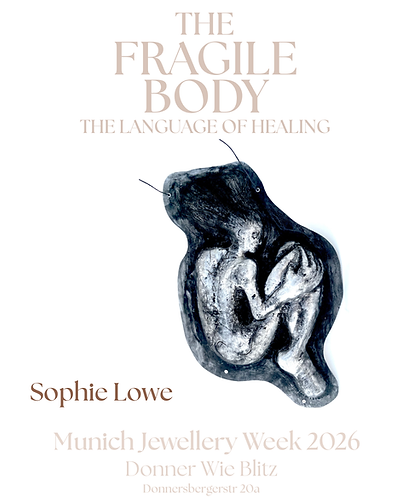
Sophie Lowe
@soph.lo
Sophie Lowe is a contemporary jewellery artist whose practice is rooted in drawing, metal, and embodied expression. Trained in 3D Design (Metals) at Middlesex University and Jewellery at Radford University in Virginia, USA, she works fluidly across precious and non-precious metals, translating her daily drawing practice into sculptural, wearable forms.
Her recent exhibitions include I DON’T SHINE. I have something to say (Venice, 2025), Jewelry and Freedom (Porto, 2024), Pins and Posters (Amsterdam, 2024), Meanings and Messages (ACJ, 2022), Glasshouses (ACJ, 2021), and Connections / Connessioni (ACJ, 2019/20). Across these contexts, Lowe’s work consistently positions jewellery as a carrier of voice rather than decoration.
For The Fragile Body: The Language of Healing, Lowe presents works created through repoussé in aluminium, using the technique as a form of three-dimensional, bas-relief drawing. Her figures emerge as ancient, scarred, and resolute. Visual witnesses to histories of violence, protest, and endurance directed at women. Gnarled and marked, they embody both vulnerability and resilience, holding the dual roles of healer and protector.
The atmosphere within the work, as in the song, describes the pain, subjugation, shaming and ruin of a woman carrying a child. Of the duel inequality of both social class and sex; it tells the story of pregnancy thought rape and lack of education and raises what would have been unheard and shunned, yet conveys resistance, Injustice, revenge and resilience.
These forms are not passive. They are alert, watchful, and charged with emotion. In Lowe’s work, the fragile body is not silent: it remembers, resists, and bears witness. Healing here is not softness alone, but the slow awakening of strength. An insistence on presence, voice, and survival.

Stephie Morawetz
@stephiemorawetz
Stephie Morawetz is an Austrian artist whose practice moves fluidly between contemporary jewellery, social engagement, and critical design. With a background spanning millinery, gemstones, and fine art, Stephie studied in Linz, Idar-Oberstein, and Tel Aviv. Her work is shaped by both material sensitivity and social awareness. She is a founding force behind NOD (Not Only Decoration), a non-profit organisation devoted to socially and environmentally conscious jewellery, and a long-standing member of the female jewellery collective Astonish. Her work has been exhibited internationally and is held in collections including the Museum of Applied Art Vienna. In 2024, she received the Silver Spur Award at the Legnica Silver Festival for creative courage and an uncompromising artistic stance.
For The Fragile Body: The Language of Healing, Morawetz presents Bloommarks II, a project that reconsiders healing as an act of acceptance rather than erasure. Using silver temporary tattoos, she transforms scars into delicate blooming flowers. The marks remain visible, intentionally, acknowledging that the body’s history cannot, and should not, be undone.
In this work, scars become sites of quiet beauty and resilience. Healing is framed not as returning to an imagined ideal, but as learning to see the body with care, honesty, and tenderness. By gently adorning the body’s marks, Morawetz invites a shift in perception: from shame to recognition, from concealment to acknowledgment. Bloommarks II offers jewellery not as decoration, but as a soft, empowering language. One that allows the body to be seen as it is, carrying its stories openly.

Teresa Faris
@teresafrankfaris
Teresa Faris’ practice probes the fragile boundary between the human and the non-human, where power, fear, and language quietly determine whose bodies are protected and whose are diminished. Drawing on philosophy, neuroscience, and social history, her work traces how anthropomorphism and dehumanisation operate in parallel: animals are softened, humanised, and made palatable, while people. Particularly women, the ill, and those marked as “other” are stripped of humanity and reduced to metaphor, spectacle, or insult.
Her series Collaboration with a Bird (CWaB) presents objects that resemble toys or calming devices. Familiar, almost comforting forms that mask deeper unease.
These works ask us to confront how we coexist with animals and, by extension, how we relate to vulnerability, dependency, and control. The objects function as provocations rather than answers, unsettling the viewer’s assumptions about care, hierarchy, and empathy.
Within The Fragile Body: The Language of Healing, Faris’ work exposes how fragility has been historically weaponised. Used to justify exclusion, medical violence, and social erasure. While also reclaiming fragility as a shared condition. By revealing the mechanisms through which bodies are classified, named, and disciplined, her work insists that healing cannot occur without first acknowledging these inherited structures of harm.
Faris’ objects do not offer comfort in the conventional sense. Instead, they demand attention, awareness, and responsibility. Healing, in this context, becomes an ethical act: the courage to recognise the ways we participate in systems that dehumanise, and the willingness to imagine more conscious, compassionate forms of coexistence.

Teresa Milheiro
@milheiroteresa
With more than four decades of artistic practice, Teresa Milheiro approaches jewellery as a form of contemporary art that expands into sculpture, narrative, and critical inquiry. Trained at António Arroio Art School, IADE, and AR.CO, her work moves fluidly between jewellery, object, performance, and installation, often engaging with themes of power, vulnerability, memory, and social history. Her practice is marked by rigorous research, material experimentation, and a fearless engagement with difficult subjects.
For The Fragile Body: The Language of Healing, Milheiro presents The Power of Fragility (2019), a work that confronts the violent history of lobotomy. A medical procedure once used predominantly on women deemed “hysterical” or socially disruptive. Reworking found medical and domestic objects, Milheiro transforms a cutlery box into a doctor’s bag containing glass and chrome-plated elements that allude to instruments of control and harm.
The work holds a sharp tension between delicacy and brutality: fragile glass set against cold metal spikes, sensitivity against repression. Here, fragility is reclaimed not as weakness, but as emotional intelligence, resistance, and power. Milheiro’s piece asks us to remember, to question, and to acknowledge how healing begins with truth.

Ute van der Plaats
@utevanderplaats
Ute van der Plaats is a German contemporary jewellery artist based in Belgium, whose practice centres on porcelain. Often referred to as white gold. Drawn to its paradoxical nature, she explores the tension between porcelain’s fragile appearance and its inherent strength and durability. Through continuous experimentation, van der Plaats combines traditional craftsmanship with modern technologies, pushing the boundaries of jewellery-making while remaining deeply attentive to material, process, and meaning. Nature frequently informs her work, alongside social and political themes that demand care, reflection, and response.
For The Fragile Body: The Language of Healing, van der Plaats presents Layers of Fragility, a brooch shaped by the experience of witnessing Alzheimer’s disease. The work reflects the slow, devastating erosion of memory, identity, and communication. The transformation of a loved one into someone both present and absent. Layer by layer, the piece mirrors this disintegration, while also holding space for love, remembrance, and dignity.
Porcelain is paired with printed transparencies of flowers. Dried, pressed, photographed, digitally altered. Suspended between acrylic glass and held together with silver and magnets. These delicate strata speak of loss and persistence, fragility and endurance. Jewellery becomes a language when words fail: a quiet act of care that preserves personality, tenderness, and presence within vulnerability.

Virág Luca Boncz
@luca_boncz
Virág Luca Boncz’s work moves between intimacy, vulnerability, and emotional endurance, translating inner psychological landscapes into material form. Her practice gives shape to experiences that are often invisible or silenced. Pain, shame, anxiety, and the slow process of acceptance. Using fragile materials as carriers of memory and meaning.
My Mother Scolded Me For It… draws from Hungarian folk songs, where collective knowledge and unspoken social codes are embedded. Disposable paper tissues stand in for invisible female labour. Ever-present, necessary, and easily forgotten. Exposed outdoors, the pierced tissues slowly dissolve, mirroring how shame, memory, and inherited expectations erode over time.
In Possible Side Effects – Disturbance, Boncz materialises panic disorder and anxiety through a patchwork quilt and a sleep mask made of 1,350 hand-formed pill replicas. Fragile, intimate materials turn the bed into both a site of rest and crisis, creating space for empathy, recognition, and shared vulnerability.

Yingying Qiu
@yingyingqiu
Yingying Qiu is a contemporary jewellery artist working between London and China. Her practice explores touch as a quiet language, examining fragility, care, and the emotional dynamics between body and object. Trained at the Royal College of Art and the China Academy of Art, she works across jewellery, soft sculpture, and material research, using textiles, silicone, silver, and organic structures to investigate non-verbal forms of communication and healing.
In her work for The Fragile Body: The Language of Healing, Qiu approaches the body as a site of vulnerability and attentiveness. Soft, dispersed forms rest on intimate areas of the body, echoing gestures of protection, soothing, and quiet repair. Rather than depicting injury, her pieces trace what forms around emotional rupture: tenderness, resistance, and the careful negotiation of remaining open while fragile.
Touch becomes central when words fall short. Through texture, repetition, and closeness, Qiu’s jewellery acts as a companion to the emotional body, offering a sensory vocabulary of care. Her work reflects on how bodies absorb pressure, how softness can endure, and how healing can unfold through tactile presence rather than resolution.

Yuqi Fan
@alicivia
Yuqi Fan is a multidisciplinary artist based in New York, working across jewellery, photography, and painting. Her practice explores the emotional bonds between people and their cherished objects, drawing from subcultures such as doll-keeping and research into loneliness, attachment, and intimacy. Through this lens, jewellery becomes a vessel for memory, desire, and identity—an object that absorbs feeling and offers companionship.
In her work for The Fragile Body: The Language of Healing, Fan examines jewellery’s closeness to the body and its capacity to soothe. Inspired by the psychology of object attachment, she explores how caring for an object can become a way of coping with isolation. Elements drawn from doll bodies reference imagined companions and mirrored selves, inviting touch, holding, and adjustment. These gestures of care echo acts of healing: attentiveness, softness, and presence.
Rather than decoration, Fan’s jewellery functions as a companion—something to nurture and be nurtured by. Her work reflects on how objects can support us when human relationships feel uncertain, revealing the fragile yet resilient ways we seek connection, comfort, and belonging.

Ziqi Yuan
@ziqi_yuannn
Ziqi Yuan is a Chinese artist based in Detroit, working across metal, fibre, and ceramics. Her practice inhabits the quiet space between permanence and fragility, shaped by personal memory, bodily awareness, and the subtle marks left by everyday life. With a background in jewellery and metalsmithing, she creates objects and installations that function as intimate records—of time passing, care given, and presence slowly shifting. Through repetition and gentle transformation, her work becomes a form of tender accounting: what remains, what fades, and what is carried forward.
For The Fragile Body: The Language of Healing, Yuan presents a garment bag formed from the traced outline of her grandmother’s body. The work began with a simple act: asking her mother to trace her grandmother’s body onto fabric and send it from China to the U.S. In translating this fragile outline into an object, Yuan confronts the quiet cruelty of time—the physical shrinking of a woman who spent her life caring for others. What emerges is not loss, but transfer: a sense that presence moves generationally, flowing from grandmother to mother to daughter.
The piece speaks to care that is never spoken aloud, to love transmitted without language. It reflects on womanhood as something inherited rather than chosen, passed down through bodies, gestures, and instinct. In this work, fragility is not disappearance—it is continuity, reshaped. Healing lives in the act of noticing, of holding space for what has been given, and allowing it to transform.